Aircon Gas Leak: Signs, Dangers & What to Do
Learn how to spot aircon gas leak signs, understand the health risks of refrigerant leaks, and know when to call a technician. Covers R22, R410A & R32.

Philips
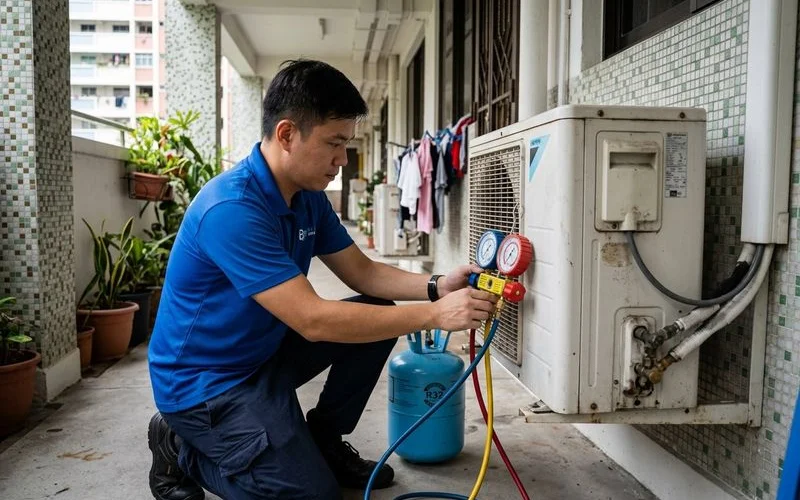
You know how frustrating it is when a unit slowly loses its cooling power over a few weeks. Many homeowners in Singapore immediately assume they just need a routine gas top-up. But adding refrigerant without sealing the actual leak is like pouring water into a cracked glass.
The gas will simply escape again.
Our team at Billy Aircon started back in 2003 with just five people, and today our 26 technicians see this exact cycle play out daily in estates across the island. The root cause is almost always a slow leak hidden somewhere in the system. Let’s look at the data, what it is actually telling us, and explore a few practical ways to respond.
Warning Signs of an Aircon Gas Leak
Refrigerant leaks rarely happen overnight. They typically develop slowly through pinhole corrosion, vibration-loosened joints, or wear at the pipe connections.
A standard set of SWG22 copper pipes in a Singapore HDB flat usually lasts between 12 and 15 years. These gradual leaks produce a consistent set of symptoms.
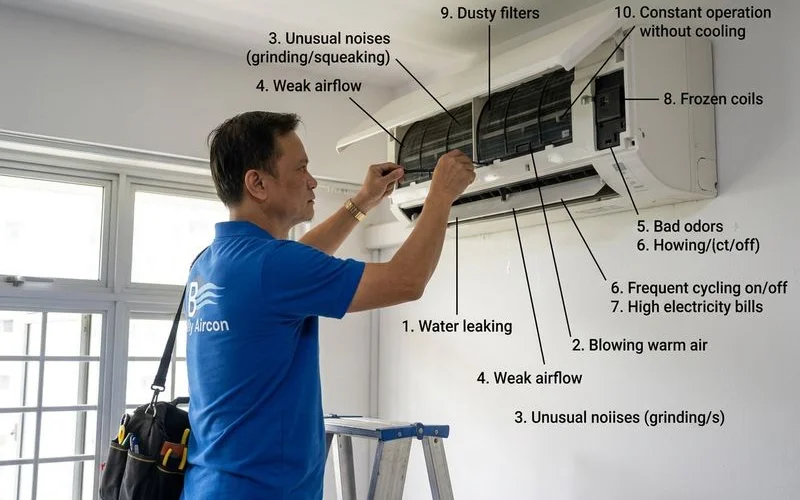
Reduced Cooling Performance
Your system runs, but the air coming out lacks that crisp chill. You keep lowering the temperature on the remote control, yet the room never reaches the set point. This happens because low refrigerant means the evaporator coil cannot absorb enough heat from the ambient air.
We always look for a specific temperature drop, known as the Delta T, across the coil. A healthy system should produce a 6 to 12 degrees Celsius temperature drop from the return air to the supply air. If you suspect an issue, an aircon not cold situation is rarely an age issue, and it is usually a refrigerant or airflow problem.
Ice Formation on the Evaporator Coil
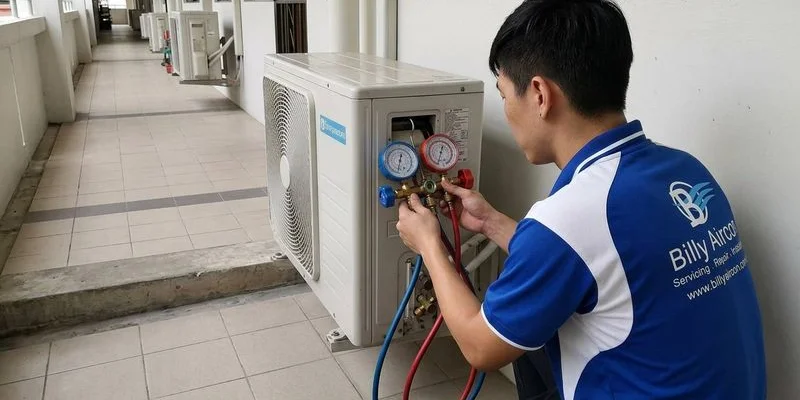
When refrigerant levels drop, the remaining gas expands more than normal inside the evaporator coil. This expansion causes the coil temperature to plummet below freezing. Moisture in the air then freezes on contact with the metal, forming a thick layer of ice.
Our technicians frequently see system pressures drop below 102 PSIG on R410A units, which forces the coil temperature down to 0 degrees Celsius. You might see frost on the copper pipes coming out of the indoor unit. A crucial insider tip is to never use a knife to chip this ice away, as you can easily puncture the delicate aluminium fins.
Hissing or Bubbling Sounds
A hissing sound near the indoor unit or along the piping points directly to gas escaping through a small hole. Bubbling sounds suggest the leak is at a joint where compressor oil and refrigerant mix.
These sounds are notoriously common near the evaporator U-bends or the flare joints connecting the indoor and outdoor units. The noises become more noticeable when the unit first starts up or shuts down. Pressure changes make the escaping gas much more audible during these cycles.
Higher Electricity Bills
When refrigerant is low, the compressor works harder and runs longer to achieve the same cooling output. This increased runtime translates directly to higher electricity consumption. Sometimes this forces the system to use 20 to 40 percent more power than normal operation.
With the SP Group Q1 2026 household electricity tariff sitting at 29.11 cents per kWh after GST, a struggling compressor will hit your wallet hard. Paying attention to sudden spikes in your monthly utility bill is a smart financial move.
Compressor Short Cycling
The compressor starts and stops frequently, running for a few minutes, stopping, and then starting again. Low refrigerant causes abnormal pressure readings inside the sealed lines.
Our service logs show that these wild pressure swings trigger the low-pressure switch safety circuit. This mechanism shuts the compressor down repeatedly to prevent the motor from burning out.
Health Risks of Refrigerant Leaks
Modern refrigerants used in residential units are generally low-toxicity, but they do carry environmental and safety considerations.
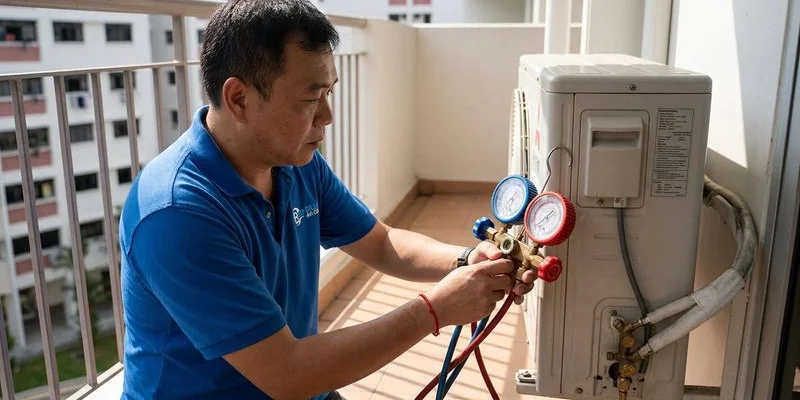
R22 (Freon), Older Units
R22 has been phased out due to ozone depletion, but it still exists in units installed before 2015. In a well-ventilated room, a small R22 leak poses minimal direct health risk. However, R22 exposed to an open flame produces phosgene gas, which is highly toxic.
We strictly follow the National Environment Agency regulations for these older systems. Any recovered R22 must be sent to a licensed Toxic Industrial Waste Collector facility for proper destruction.
R410A, Current Standard
R410A is a very common refrigerant in Singapore systems today. It does not deplete the ozone layer, but it is a potent greenhouse gas. This hydrofluorocarbon carries a high Global Warming Potential score of 2088.
In enclosed spaces with poor ventilation, a massive R410A leak can displace oxygen. This displacement causes dizziness, headaches, and very rarely, asphyxiation. Residential systems contain relatively small charges of 0.5 to 2 kg, so the risk in a normally ventilated room remains low.
R32, Newer Units
R32 is the new standard in modern models due to its lower environmental impact. It has a Global Warming Potential of just 675, which is roughly a 67 percent reduction compared to R410A. The key difference is that R32 is mildly flammable.
While it will not ignite easily under normal conditions, it requires proper handling during repair and installation. A leak near an ignition source in a confined space poses a low but real fire risk.
What to Do If You Suspect a Gas Leak
Taking the right immediate steps protects your equipment and your family.
- Do not panic. Residential refrigerant charges are small, and the risk in a ventilated room is minimal.
- Turn off the power. Switch off the unit at the isolator switch to prevent compressor damage from running on low gas.
- Open the windows. Create cross-ventilation in your HDB or condo by opening windows on opposite sides of the room.
- Do not attempt a DIY fix. Refrigerant handling requires formal certification and specialised recovery equipment.
- Call a qualified technician. You can contact Billy Aircon for same-day diagnosis and pressure testing.
How Technicians Find and Fix Gas Leaks
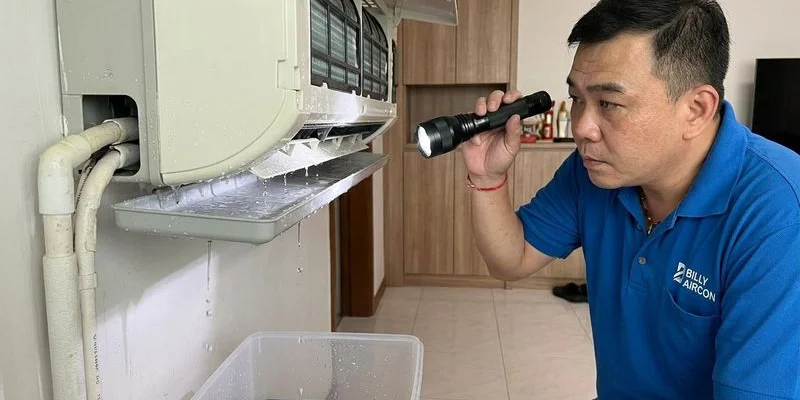
Professional leak detection removes the guesswork from the repair process.
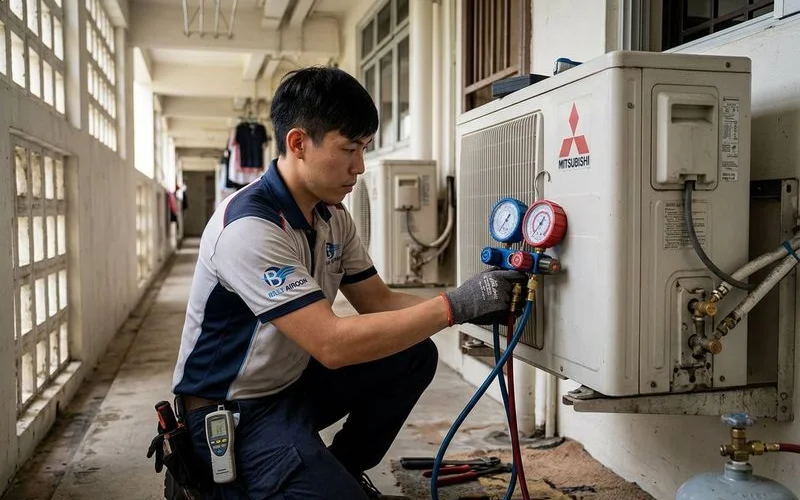
Our technicians rely on advanced tools like the INFICON D-TEK Stratus electronic leak detector. This specific device can sense trace amounts of escaping gas down to just 1 gram per year. We combine this technology with several other proven methods.
- Pressure test: Nitrogen is pumped into the sealed system at high pressure. If the gauge drops over time, a leak is officially confirmed.
- Electronic leak detector: A sensitive probe is run along all piping joints, connections, and the coils to pinpoint the exact location.
- UV dye test: For microscopic leaks, a UV-reactive dye is added to the system. Under a UV light, the dye glows brightly at the escape point.
- Soap bubble test: Soapy water applied to suspected joints will bubble up where gas is actively escaping.
Once found, the exact repair method depends entirely on the leak’s location.
| Leak Location | Typical Repair Method | Estimated Cost (SGD) |
|---|---|---|
| Flare joint | Re-tightening or re-flaring the connection | $60 to $100 |
| Pinhole in copper pipe | Brazing the hole shut with a welding torch | $100 to $200 |
| Evaporator coil | Full coil replacement | $250 to $500 |
| Old piping issues | Full piping replacement | Varies by house size |
After the repair is complete, the system is evacuated with a vacuum pump to remove moisture and air. The technician then recharges the unit with the exact required weight of fresh refrigerant.
Why Just Topping Up Gas Does Not Work
A properly sealed system operates as a closed loop and should never lose refrigerant. If your technician says you need a top-up, you must ask them to check for leaks first.
Topping up without sealing the leak creates several compounding problems.
- You will need another top-up in 3 to 12 months.
- The compressor suffers ongoing stress from constantly fluctuating pressure levels.
- You pay $80 to $180 per top-up repeatedly instead of fixing the root cause once.
- Refrigerant released into the atmosphere directly contributes to climate change.
At Billy Aircon, we always check the system integrity before performing any gas top-up. If we discover a leak, we provide transparent pricing for the permanent repair alongside the temporary top-up cost. This approach ensures you can make a fully informed financial decision.
Prevention
Regular aircon servicing allows technicians to check gas pressure levels at every single visit. Catching a slow leak early, before you even notice a cooling loss, prevents compressor burnout and keeps repair costs manageable.
For the hot and humid Singapore climate, quarterly aircon servicing in Singapore is the industry standard for optimal performance. For units over 5 years old, ask about a chemical wash, which includes a thorough inspection of all pipe joints and the coil condition. Book a routine check today to protect your investment and enjoy uninterrupted cooling.
Need Professional Aircon Help?
Our experienced technicians are ready to help. WhatsApp us for a fast response — 24 hours guaranteed.
WhatsApp Us Now