Aircon Piping: Types, Common Problems & When to Replace
Complete guide to aircon piping in Singapore — copper pipe types, common problems like leaks and corrosion, replacement costs, and when to reuse existing pipes.

Philips
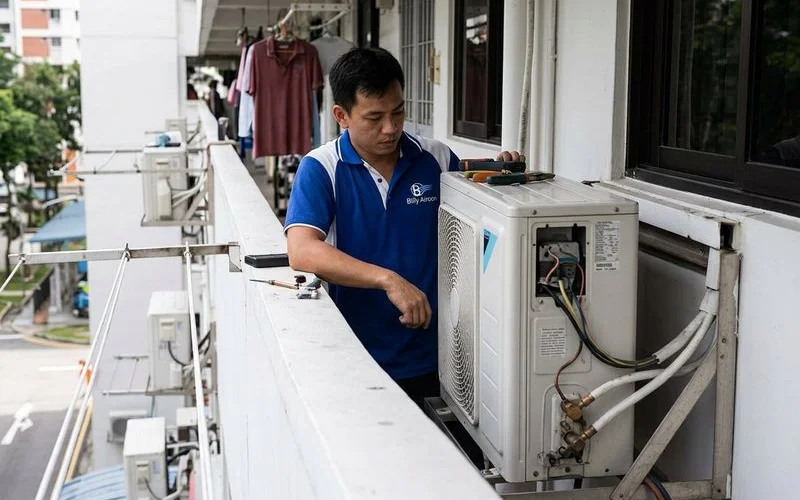
Many property owners focus entirely on the air conditioning brand while completely ignoring the network hidden behind their walls. The copper pipes connecting your indoor and outdoor units function as the system’s vital circulatory system. Refrigerant flows through these lines continuously to absorb heat inside and release it outdoors.
Since starting Billy Aircon in 2003 with just five technicians, we have seen countless premium units underperform due to compromised infrastructure. A faulty setup ruins energy efficiency very quickly. When the piping experiences leaks, flow restrictions, incorrect sizing, or degraded insulation, your electricity bills will spike while cooling capacity drops.
Our team of 26 dedicated specialists often finds that the root cause of an uncomfortably warm room is a hidden pipe issue. Let us examine the exact components inside your trunking and break down the common failure points. I will also share the realistic costs you can expect for repairs and replacements in Singapore right now.
What’s Inside the Pipe Bundle
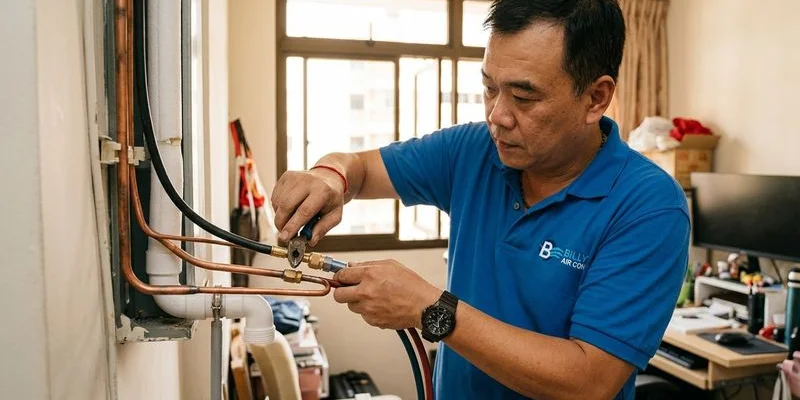
What looks like a single thick PVC trunking actually houses four distinct components. Each part plays a specific role in keeping your property cool.
Liquid Line (Small Copper Pipe)
The smaller copper pipe carries high-pressure liquid refrigerant from the outdoor compressor into your room. Standard residential units typically use a 6.35mm (1/4 inch) diameter pipe for this task.
This line runs at a moderate temperature during operation. Installers sometimes leave it uninsulated, though wrapping it does improve overall efficiency slightly.
Suction Line (Large Copper Pipe)
The larger copper pipe returns cold, low-pressure gaseous refrigerant back to the outdoor unit. System capacity dictates the size, usually requiring either 9.52mm (3/8 inch) or 12.7mm (1/2 inch) diameters.
We always emphasise the importance of wrapping this specific line thoroughly. The surface temperature drops to between 5°C and 15°C during operation.
Singapore’s dew point hovers around 24°C, meaning condensation will immediately form on bare metal. Proper wrapping prevents serious water damage to your ceilings and walls.
Drain Pipe
A PVC pipe carries condensate water away from the indoor drain pan to a designated external floor trap. Standard installations use either 16mm or 20mm diameter PVC materials.
This line relies entirely on gravity to move water. Installers must maintain a constant, slight downward slope along the entire run to prevent stagnant water from backing up into your bedroom.
Electrical Control Cable
A multi-core flexible cable transmits both communication signals and power between the two units. Most modern inverter systems require a 3-core or 4-core configuration.
Our technicians always check that these cables carry the proper Singapore safety marks. This wiring allows the indoor blower to command the outdoor compressor to start, stop, and adjust its variable speed.
The entire bundle is wrapped securely in black insulation tape and routed through protective PVC trunking.
Pipe Sizes and Lengths
Standard Residential Pipe Sizes
| System Capacity | Liquid Line | Suction Line |
|---|---|---|
| 9,000 BTU (1 HP) | 6.35mm (1/4”) | 9.52mm (3/8”) |
| 12,000 BTU (1.5 HP) | 6.35mm (1/4”) | 9.52mm (3/8”) |
| 18,000 BTU (2 HP) | 6.35mm (1/4”) | 12.7mm (1/2”) |
| 24,000 BTU (2.5 HP) | 9.52mm (3/8”) | 15.88mm (5/8”) |
Using the wrong copper dimensions causes immediate performance issues. Undersized lines restrict the flow of gas, which starves the compressor and slashes cooling capacity. Oversized lines reduce the velocity of the gas, making it difficult for essential lubricating oil to return to the compressor.
We strongly recommend specifying SWG 22 (0.71mm thick) copper pipes for modern installations. The R32 refrigerant used in current models operates at significantly higher pressures than older gases. Thinner SWG 23 pipes are prone to splitting under this intense pressure over time.
Maximum Pipe Length
Most wall-mounted split systems work best with runs between 15 and 20 metres. Pushing beyond these limits causes significant pressure drops in the system.
- Up to 15m: Standard operation requires no special adjustments.
- 15 to 25m: Technicians must usually weigh and add extra refrigerant charge.
- 25m and above: Requires specialised VRV or VRF equipment designed for long distances.
Our typical HDB installation projects usually require just 3 to 8 metres of materials from the bedroom to the aircon ledge. Condominiums and landed properties frequently demand much longer runs, especially if the outdoor compressor sits on a high roof.
Common Piping Problems
Refrigerant Leaks at Flare Joints
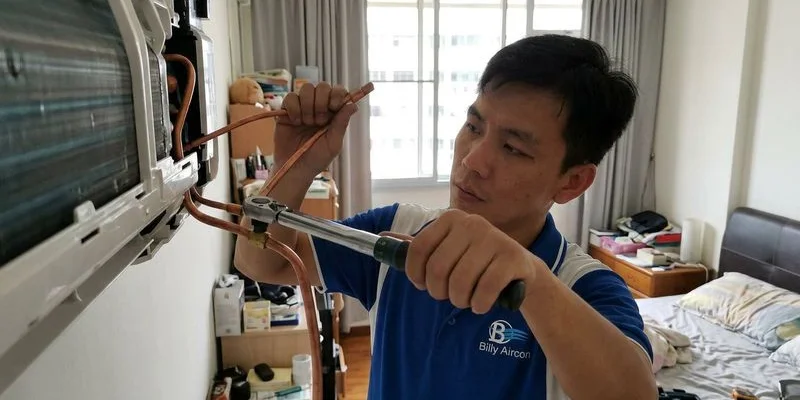
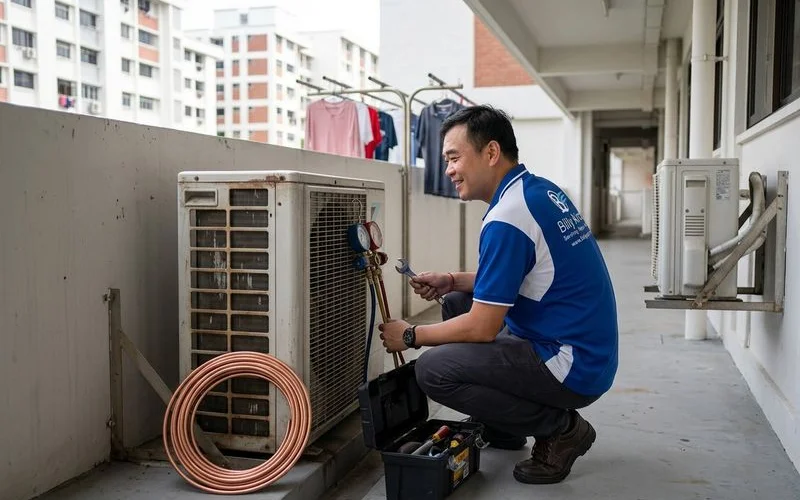
The flare connection represents the most common failure point in any setup. These cone-shaped copper fittings secure the lines to both the indoor and outdoor hardware.
We frequently encounter leaks caused by poor workmanship at these critical junctions. If a technician under-tightens the flare nut, gas escapes slowly over several months. Overtightening crushes the soft copper and creates immediate micro-fractures. Thermal expansion and contraction also cause these joints to loosen naturally as the years pass.
You might notice oil residue around the brass fittings, hear a faint hissing sound, or experience gradual cooling loss. Fixing this requires a professional to cut the copper, create a fresh flare, and secure the joint with a calibrated torque wrench.
This repair typically costs between $60 and $100.
Pinhole Corrosion
Formicary corrosion creates microscopic, tunnel-like holes completely through the metal wall. Exposure to organic acids causes this specific type of chemical reaction.
Our repair crews see this constantly in newly renovated flats. Fresh paint, new carpentry adhesives, and modern cleaning products release high levels of volatile organic compounds (VOCs). Singapore’s extreme humidity traps these gases indoors, accelerating the chemical reaction against the copper.
A powdery green patina on the surface is a clear visual warning that active corrosion is eating through the metal. A technician can sometimes braze a tiny leak, but extensive green spotting usually requires a full material replacement.
Kinked or Crushed Pipes
Sharp bends created during a rushed installation will severely restrict the flow of gas. Other contractors sometimes accidentally crush the hidden trunking while installing false ceilings or custom wardrobes.
A kinked liquid line immediately throttles your cooling capacity. A damaged suction line traps circulating oil, which eventually destroys the outdoor compressor through friction.
Our specialists can sometimes straighten minor bends carefully. A severely crushed section demands cutting out the ruined metal and brazing a fresh piece into the circuit, costing roughly $100 to $200.
Insulation Deterioration
When the insulation on the suction line degrades, the freezing metal is suddenly exposed to warm, humid air. Condensation forms instantly and drips constantly.
This dripping water ruins plasterboard ceilings and promotes unhealthy black mould growth. The exposed metal also absorbs ambient heat from the ceiling void, forcing your compressor to work much harder to achieve the target temperature. We recommend using Class 0 Armaflex foam at a minimum thickness of 1/2 inch to survive local humidity levels.
Replacing degraded foam sections usually costs between $50 and $150, depending heavily on how easily technicians can access the trunking.
Blocked or Kinked Drain Pipe
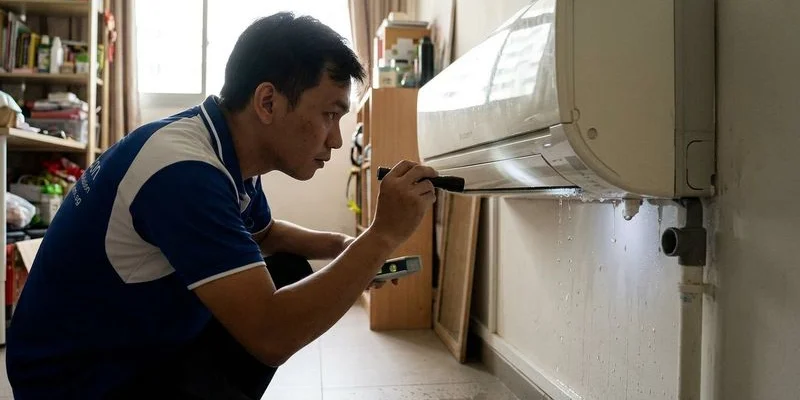
The PVC drain line frequently clogs with a thick, jelly-like bacterial slime. Bending the rigid plastic too sharply around tight corners also creates low points where water stagnates.
This pooled water eventually overflows the indoor drip tray and runs directly down your bedroom wall. Flushing the blockage with pressurised gas or chemicals costs about $50 to $80. Rerouting a poorly designed gradient will run between $80 and $150.
When to Replace Piping
Reuse vs Replace
Property owners frequently ask if they can save money by reusing existing materials when buying new hardware. The answer relies entirely on the condition and specifications of the current setup.
You can safely reuse existing materials when:
- The copper is less than 5 years old and free of green oxidation.
- The existing diameters match the new hardware specifications exactly.
- There is zero history of previous refrigerant leaks.
- The protective foam is intact or recently upgraded.
- The new hardware uses the exact same chemical gas as the old system.
You must invest in complete replacement when:
- The network is older than 8 to 10 years.
- Technicians spot visible pitting or heavy green oxidation.
- You have a documented history of gas leaks or frequent chemical top-ups.
- The physical dimensions do not match the requirements of the new hardware.
- The foam wrapping is crumbling and brittle throughout the entire property.
Important: Refrigerant Compatibility
Older R22 equipment operated at much lower pressures than modern R410A and R32 hardware. The old R22 setups also relied on a mineral-based lubricating oil.
We refuse to mix these incompatible chemicals. Modern gases use synthetic POE oil, which reacts violently with leftover mineral oil to create a thick, system-destroying sludge. Most major manufacturers will void your warranty immediately if you attempt to push R32 gas through uncleaned, legacy R22 infrastructure.
Piping Costs in Singapore
| Service | Typical Cost |
|---|---|
| New piping (per metre, installed) | $25-$40 |
| Standard HDB pipe run (3-5m) | $150-$250 |
| Long pipe run (8-15m) | $300-$600 |
| Trunking (per metre) | $15-$25 |
| Flare joint repair | $60-$100 |
| Brazing repair (pinhole) | $100-$200 |
| Full pipe replacement (typical HDB) | $200-$400 |
Contractors usually bundle these expenses directly into their standard installation packages. You should always request a fully itemised quote that separates the hardware price from the raw material costs.
Our estimators provide this breakdown so clients can compare quotes accurately. Keep in mind that 2026 pricing reflects both current global copper commodity rates and the standard 9% GST in Singapore.
Quality Matters
Accepting the lowest bid for infrastructure work is a guaranteed false economy. Low-grade thin copper, rushed flaring techniques, or skipping the mandatory nitrogen pressure test will guarantee leaks within a few short months.
We use only premium ASTM B280 certified refrigeration-grade copper tubing for every project. Technicians on our staff always perform high-pressure nitrogen tests to verify absolutely leak-free joints before releasing any refrigerant into the system.
If you are currently experiencing weak airflow, unexplained gas loss, or persistent water dripping, the hidden infrastructure might be the culprit. Reach out and contact Billy Aircon to arrange a thorough diagnostic inspection. I guarantee our team will check every visible joint, test the pressures, and provide honest guidance on whether a targeted repair or a full replacement makes the most financial sense. Regular aircon servicing keeps your piping in top condition and prevents costly refrigerant losses.
Need Professional Aircon Help?
Our experienced technicians are ready to help. WhatsApp us for a fast response — 24 hours guaranteed.
WhatsApp Us Now