Aircon Thermistor: What It Does & Signs It Needs Replacing
Your aircon thermistor controls temperature accuracy. Learn how it works, symptoms of failure, testing methods, and replacement costs in Singapore.

Philips
We often notice that many homeowners blame the compressor for cooling issues. The truth is that the biggest headaches often come from the smallest parts. Since Billy Aircon was founded in 2003, our team has grown from just five people to 26 dedicated technicians keeping Singapore cool, and we frequently trace erratic temperature swings back to a tiny component known as the aircon thermistor.
These sensors act as the brain of your unit.
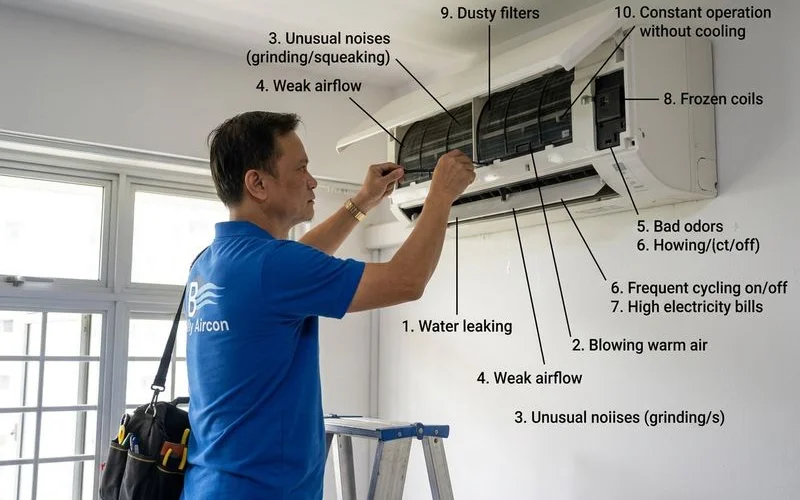
Your aircon does not have eyes, but it knows the room temperature, the coil temperature, and the pipe temperature because of these parts. When they fail, the system loses its ability to regulate climate accurately, leading to rooms that are freezing or units that refuse to stop running. Let us look at the data, what it is actually telling us, and explore practical ways to respond.
What Is an Aircon Thermistor?
We define a thermistor as a temperature-sensitive resistor made from specialised ceramics or polymers. Its electrical resistance changes predictably as the ambient heat level shifts. Our standard procedure involves checking the PCB (printed circuit board), which sends a small electrical current through the sensor and measures the resistance. From that specific resistance value, the system calculates the exact temperature in seconds.
This rapid calculation is how your aircon knows when the room has reached your set temperature and tells the compressor to cycle off. Manufacturers like Shibaura Electronics and Panasonic design these parts to detect thermal changes almost instantly. Our experience shows that this fast response is also how the system detects dangerous conditions like a frozen evaporator coil or an overheating compressor.
Pro Tip: Modern inverter aircons rely on high-speed NTC (Negative Temperature Coefficient) thermistors to adjust compressor speeds in real-time. This instant feedback loop is the exact mechanism that saves you money on electricity compared to older non-inverter models.
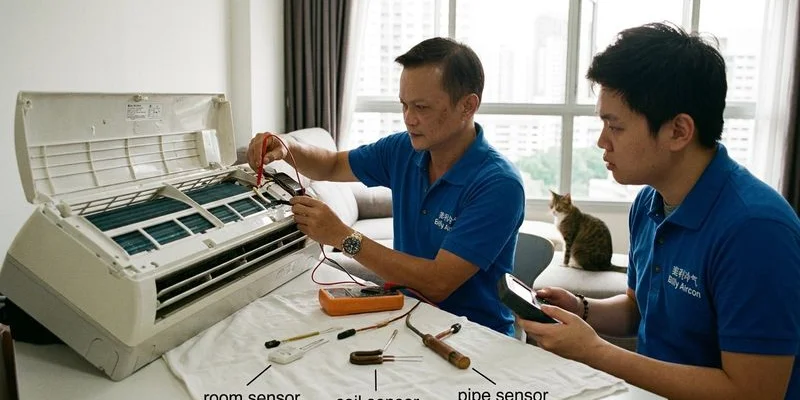
Types of Thermistors in Your Aircon
We find that most split-system units contain at least three distinct sensors. Each one serves a highly specific function.
- Room temperature thermistor (indoor): Located on or near the return air intake of the indoor unit. It measures the ambient room temperature and compares it to your set temperature. This is the sensor that determines when to start and stop the compressor.
- Coil temperature thermistor (indoor): Attached directly to the evaporator coil. It monitors coil temperature to prevent freezing. If the coil drops below about 0°C, this sensor signals the PCB to stop the compressor and run the fan to defrost.
- Pipe temperature thermistor (outdoor): Monitors the discharge pipe temperature on the outdoor unit. It protects the compressor from overheating by triggering a shutdown if temperatures exceed safe limits.
Some high-end units feature additional sensors for the outdoor coil temperature, outdoor ambient temperature, and liquid pipe temperature.
Symptoms of a Faulty Thermistor
Room Won’t Reach Set Temperature
We frequently respond to service calls where the room feels uncomfortably warm. If the room sensor reads incorrectly and thinks the room is 22°C when it is actually 26°C, the compressor will shut off too early. This false reading is one of the most common causes of an aircon that’s not cold enough. You end up sweating while the system thinks its job is done.
Compressor Runs Continuously
Our teams see the opposite problem just as often. If the sensor reports a temperature higher than actual, the compressor never receives the signal to stop. It runs continuously, overcooling the room and drastically wasting electricity. The SP Group electricity tariff for Q1 2026 sits at $0.2911 per kWh, meaning a constantly running unit will cause your bill to spike rapidly. A compressor forced to work without breaks will also see its standard 10 to 15-year lifespan cut remarkably short.
Short Cycling
We classify short cycling as a situation where the compressor starts and stops rapidly. The unit might run for a brief 10-minute burst, stop completely, and then start again almost immediately. This intermittent fault is incredibly hard on the mechanical parts. The system uses the most energy during startup, so this constant on-and-off process destroys energy efficiency. Frequent restarting reduces the equipment lifespan significantly and guarantees an expensive repair down the line.
Ice on the Evaporator Coil
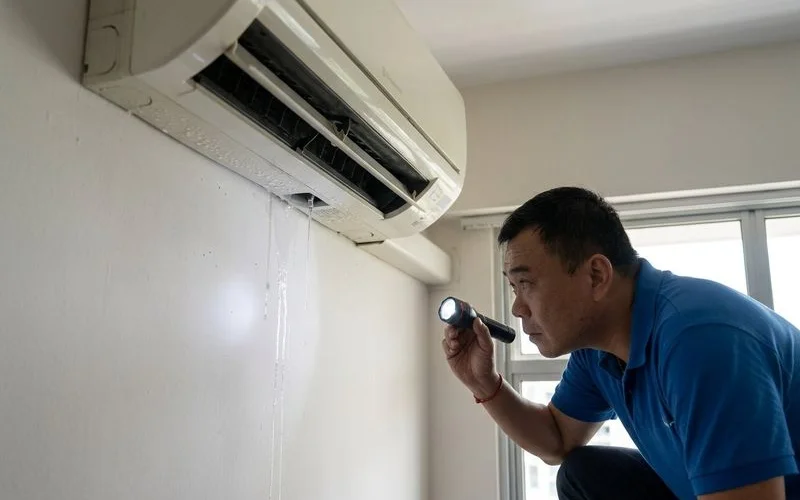
Our technicians know that a failed coil sensor eliminates the system’s vital freeze protection. Singapore experiences high humidity levels that regularly exceed 80%, which means excess moisture is always present in the air. The evaporator coil can drop well below freezing, rapidly building up a thick layer of ice from that moisture. You will notice reduced airflow, water dripping as ice melts, and eventually the unit may trigger a blinking error light.
Error Codes
We always check for specific manufacturer error codes during a diagnostic visit. Most modern units display specific alphanumeric sequences for sensor failures to help isolate the exact failed component. Daikin shows E7 for outdoor faults and A3 for drain issues, while Mitsubishi uses specific blink patterns for each location. Other major brands provide their own clear indicators.
| Aircon Brand | Common Error Code | Thermistor Fault Location |
|---|---|---|
| Midea | E4 | Indoor room temperature sensor fault |
| Midea | E5 | Evaporator coil temperature sensor fault |
| Daikin | E7 | Outdoor thermistor fault |
| Panasonic | F1 / F2 | Outdoor temperature sensor open circuit |
How Technicians Test Thermistors
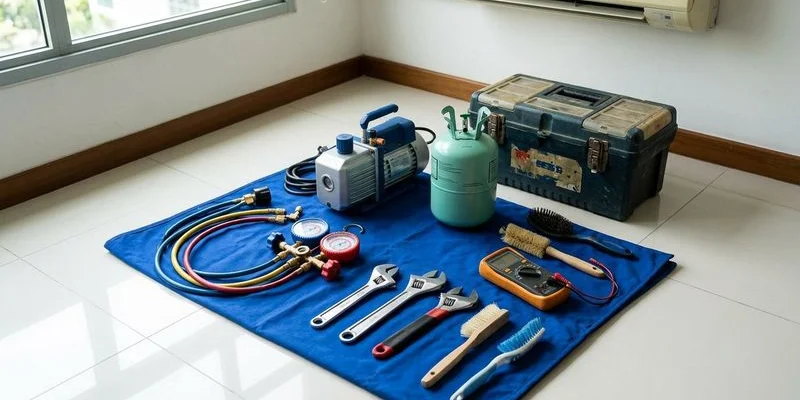
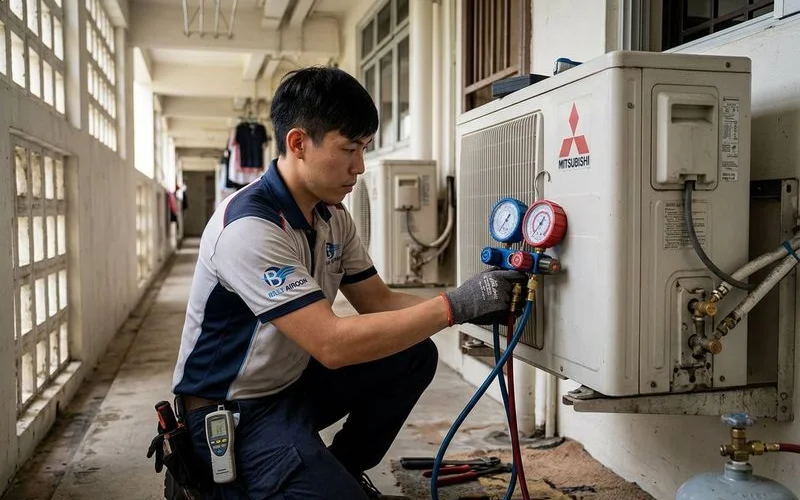
We rely on professional-grade tools like the Fluke 117 or 179 digital multimeters to diagnose these issues accurately. Testing a sensor is straightforward with the right equipment.
- Disconnect the thermistor from the PCB.
- Measure resistance with a multimeter at the current ambient temperature, which in Singapore is typically around 25°C to 27°C indoors.
- Compare to the manufacturer’s resistance chart to see what resistance the thermistor should read at each temperature.
- Check for consistency by warming the thermistor slightly with your hand and verifying the resistance changes smoothly.
Our standard benchmark is a smooth, predictable resistance change. A faulty unit may read way off spec, show erratic jumps, or display an open circuit with infinite resistance, which indicates a complete failure.
Common Resistance Values
We reference specific baseline numbers during every service visit. At a standard 25°C, most residential sensors read approximately the following values.
- 10kΩ type (most common): 10,000 ohms at 25°C
- 15kΩ type: 15,000 ohms at 25°C
- 20kΩ type: 20,000 ohms at 25°C
These values change predictably with the heat. For a standard 10kΩ NTC sensor, a hot 30°C day will cause the resistance to drop to roughly 8,000 ohms.
Replacement
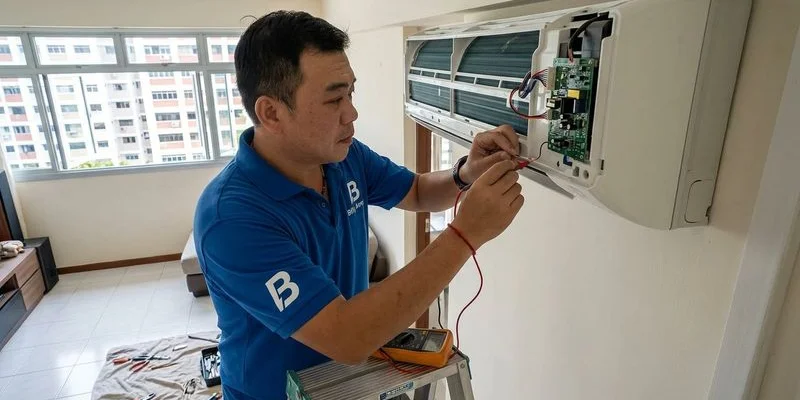
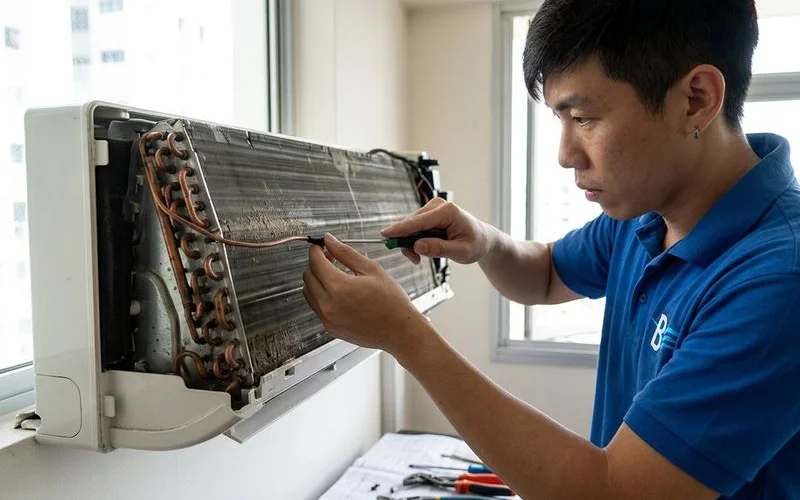
We consider sensor replacement to be one of the more straightforward repairs. A skilled technician can usually complete this entire process in 30 to 45 minutes.
- Identify the correct thermistor type and resistance rating for your unit.
- Disconnect the old sensor from the PCB connector.
- Remove the sensor from its mounting position on the coil or pipe.
- Install the new sensor in the exact same position, because precise placement dictates accurate readings.
- Reconnect the wire to the PCB.
- Test operation and verify the unit responds correctly to temperature changes.
Replacement Costs in Singapore
Our transparent pricing models account for both parts and skilled labour.
- Thermistor part: $15 to $40 depending on the brand and specific part number, like the Panasonic A50C00611.
- Labour: $50 to $80.
- Total typical cost: $80 to $150.
These figures reflect standard market rates. We advise comparing this minor repair to the cost of running a compressor continuously. At the 2026 SP Group rates, a faulty sensor could easily waste $50 to $100 extra per month in electricity. Early replacement is always the most economical choice compared to an $800 to $2,000 compressor replacement if short cycling causes permanent damage.
Genuine vs Compatible Parts
We strongly recommend using genuine OEM parts for these specific repairs. Original parts typically feature a strict 1% tolerance for accuracy. Compatible aftermarket sensors might have the correct resistance at room temperature, but their variance can swing up to 5% across the full operating range.
A sensor that reads correctly at 25°C but is off by 3°C at 5°C will cause coil freezing issues that are incredibly difficult to diagnose later on.
Prevention
We know that the sensors themselves do not require active maintenance, but their connections and mounting clips absolutely degrade over time.
- During servicing: Ask your technician to check thermistor connections during regular aircon servicing. Loose connectors at the PCB cause intermittent faults.
- After chemical wash: Verify thermistor placement after a chemical wash, as the high-pressure cleaning process can sometimes shift sensors from their optimal position.
- Age consideration: Components in units over 8 years old are highly prone to drift and inaccurate readings. Proactive replacement during major service work is an excellent preventive measure.
Our team handles these exact issues every single day across Singapore. Routine aircon servicing catches sensor problems early, saving you from costly compressor damage. If your system is running erratically or struggling with climate control, replacing a faulty aircon thermistor is a highly likely and affordable fix. Contact Billy Aircon for fast diagnosis, as our service vehicles carry common types for same-visit replacement.
Need Professional Aircon Help?
Our experienced technicians are ready to help. WhatsApp us for a fast response — 24 hours guaranteed.
WhatsApp Us Now